“This Day in History” Websites

You know that excited-yet-also-frustrated feeling you get when you come across something that is awesome and can totally help you out in the classroom?  You have that whole, “Why haven’t I found this sooner” moment.  Well, I had that when I came across this website today.  I was looking for a particular historical picture on the Library of Congress website (which has an amazing, yet overwhelming amount of stuff on it), when I came across their “Today in History” series.

When I taught full-time, I always had a “This day in history” segment in my bell ringer.  I would display one significant historical event (not necessarily specifically related to US history) on the board and discuss it briefly with my students.  When I did it, I had to create a PowerPoint slide with a picture and explanation for each school day of the year.  It took me a while to research and create them.  I did have a book called Today in History, which helped, but it was still time-consuming.

The students really enjoyed it.  Guess what?  You don’t have to go through all of that work to do this in your classroom. You can just go here and find the date you need.  Under each link for each date, there is a page about at least one historical event which contains a picture and an explanation.  It’s really easy to navigate!  Also, each page (or at least all of the ones I checked out) had links at the bottom to related Library of Congress resources.  Even if this doesn’t become a daily feature of your classroom, you could always keep it handy in case your lesson runs short and you need a filler for the last few minutes of class.

By the way, the History Channel also has a really good This Day in History page, which is accompanied by a video.  However, the video has a commercial and sometimes the videos are slow to load.  Also, the History Channel video covers 5 or 6 topics, and sometimes it’s more effective to focus on one particular event rather than mention several briefly.  Either way, both of these resources can save you time!

 

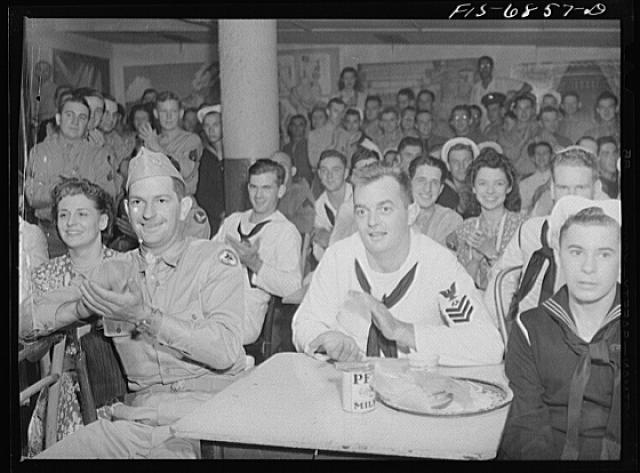
Photo:  Collins, M., photographer. (1942) New York, New York. Audience at the Stage Door canteen. Aug.?. [Image] Retrieved from the Library of Congress, https://www.loc.gov/item/owi2001009097/PP/.

Great Example of Connecting Students to Content

This!  Yes!  Yes!  A thousand times YES!  This teacher is doing it right!  If you don’t establish relevance or allow your students to form a connection to the material, they either won’t remember it or won’t care about it!  Think about it.  Have you made things so interesting or gotten such an emotional reaction out of your students that one of them actually posted about it later?  Let that be your goal today…and every day!

wifitax

LTH 012 – What to Put on Your Board

In this episode, I discuss what you should put on your board so that students, administrators, and others know what is going on in your classroom.  Stay tuned for interesting facts at the end!

What is an essential question?

Teddy Roosevelt as a young man – Fierce!

Recording of Teddy Roosevelt – Library of Congress


Intro music clip of “I Dunno” by Grapes CC BY-ND 3.0

LTH 010 – School Shootings: Have a Plan

In this episode, I’ll discuss the importance of having a plan beyond what your school provides in case you ever have to deal with an active shooter.  Stay tuned at the end for an update.

***Update:  I am sad to report that Jacob Hall passed away on October 10, 2016.

Alice Training

Active Shooter School Self-Assessment

Alice Individual Training

Jacob Hall GoFundMe Page


My Recommended Spiritual Resources for Those Who are Seeking are Listed Below:

One of my favorite videos on life’s purpose – Francis Chan

How can I have a personal relationship with God? – Chip Ingram

What is salvation?


LTH 009 – Proximity

In this episode, I’ll talk about the importance of getting up and moving around your classroom.  Stay tuned for interesting facts at the end!

Show Notes and Resources:

Video Clips on Death in the Civil War

Picture of Traveller’s Stable at Washington and Lee University


Intro music clip of “I Dunno” by Grapes CC BY-ND 3.0

LTH – 007 Using a Prop Box

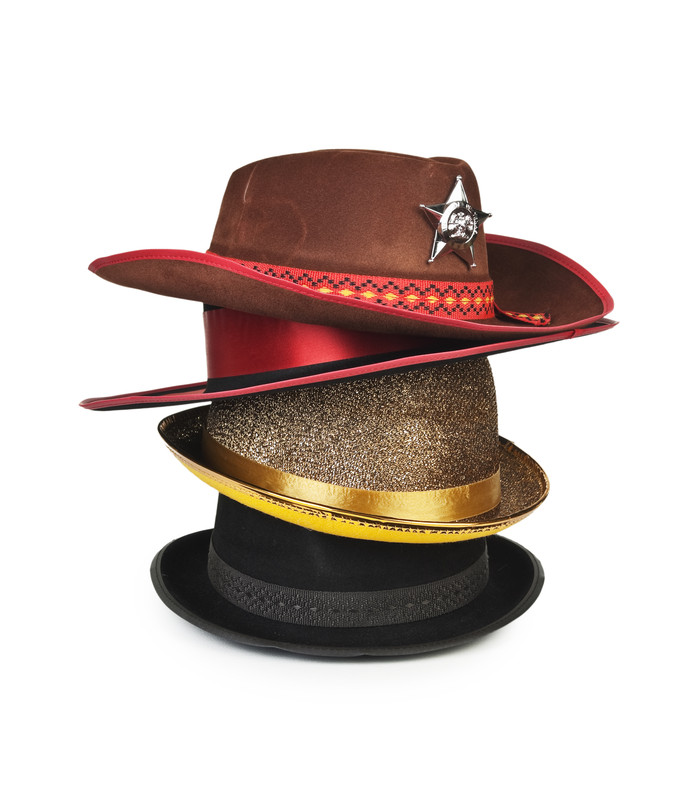
In this episode, we’ll look at how to use a box full of fun props in your classroom.  I’ll also tell you which props are helpful to have and where to get props for little or no money.

Show Notes and Resources:

Prop Box Basics


Intro music clip of “I Dunno” by Grapes CC BY-ND 3.0

The Best Review Game Ever!

It’s the day before a test. There are 20 minutes of class left. Your students look up at you with pleading eyes that say, “Please don’t make us do another review worksheet!”  You pull out the flyswatters from your cabinet in the back of the room. All of the sudden, you hear several students say, “Yessssssss!”

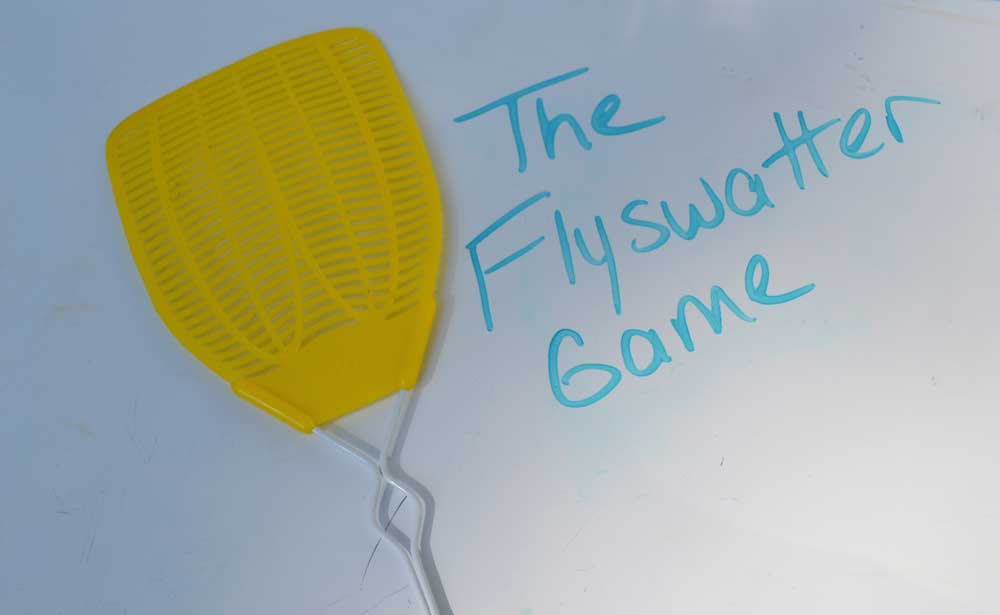
I call it “The Flyswatter Game.”  It was, by far, the most popular in-class review method amongst my students.  Most of you have probably heard or seen this type of review before, but even if you have, take a look at how I implemented the game.  Adding some basic rules and strategies can mean the difference between classroom chaos and a fun, engaging review.

The basic premise of the game is that the teacher asks questions and the students try to be the first to slap the correct answer on the board.  Sounds simple, right?  Here’s what I found was the most effective way to play the game.

Flyswatter Game Procedures
  • Write the names of 20-30 review terms on your board.  The terms should not be written in rows or columns, but written randomly and tilted diagonally.
    • If you have many terms or phrases, you may want to do something to make each phrase stand out visually.  This will help students read the terms and phrases more quickly during the game.  I used different colored markers to draw a circle around each worSlide1d.  See my example.
    • Write enough terms on the board so that each student has a least one chance to participate in a round.
  • Divide the class into 2 teams and have them move to different sides of the classroom.
  • Explain the rules.  (See below)
  • Ask for one volunteer from each team to start the game.
    • I have found that most students are enthusiastic about playing and students love to go up against their friends.  I let students choose their match-ups, with the understanding that a student cannot go twice unless all students have already had a turn.
    • It is understood that all students must participate or lose points on their participation grade for that day.  This is typically not a problem, as students tend to cheer on their teammates.
  • Ask a question whose answer is a term or phrase written on the board.
  • The first student to slap the correct answer with his/her flyswatter wins a point for his/her team.
  • When students are finished with their round, they must pass the flyswatter on to someone in their team that hasn’t gone.
  • Play continues this way for as long as necessary.  I typically did enough rounds so that each student got at least two chances to play.
  • The winning team receives candy or bonus points on a quiz or test.
Rules
  • Students must face away from the board and cannot turn around until I finish reading/saying the question.
  • Students get one slap at a time. If the student slaps the wrong answer, he must wait until the opponent slaps a term before he can slap again. If the opponent is right, the round ends.  If the opponent is also wrong, then either can slap again, until someone is wrong.  (The key here is to penalize a student for slapping a wrong answer. When I first started playing this game, students would get it wrong and just keep randomly slapping terms to try to guess the right answer before the opponent could hit anything.)  Continue the round until one of the students slaps the correct answer. If it is obvious after several slaps that neither student knows the answer and it is slowing down the momentum of the game, just have the class yell out the correct answer after so many chances.
  • Any student who uses physical force to block an opponent loses the round.
  • Any student who hits his opponent with the fly swatter automatically loses the round. (This rule and the previous one are particularly necessary when dealing with high school boys.)
  • Students who inappropriately criticize other students in the class lose a point for their team.  (This prevents a lot of those outbursts of, “Gosh, you’re so stupid!  I can’t believe you didn’t know that!”)
  • Students who try to give clues to their teammates and/or cheat will cause their team to lose the round.
Other Tips
  • I typically didn’t have questions written down.  I just looked at the terms on the board and made up a question on the spot.
    • If you do this, be aware that some evil-genius students eventually try to watch your eyes and see where on the board you are looking in order to figure out where to slap.  To avoid giving away the answer, simply look at various parts of the board each time and don’t look at the answer word right before you say the question.
  • Some terms can be the source of multiple questions, which can enable you to do more rounds in a game, even though your list of terms may be limited.  For example, the term “John Adams” may be on the board.  Throughout the game, you can ask several different questions for which he is the answer.
  • Students tend to get close to the board, thinking this will help them slap the answer first, but it actually limits their field of vision.  Encourage students to take a few steps back from the board so that they can see all of the terms at once.
  • Use two different colors of fly swatters so that it will be easier to see who slaps first.
  • Students who are often hesitant or don’t know much material typically tend to go towards the end of each cycle.  If necessary, modify the questions to meet the needs of the students in that round (ask easier questions for students who need them).
  • Be aware of student height and arm length when you pick a term. If you have a short student going up against a tall student, pick a term that they can both reach easily.
  • If, for some reason, you miss a slap, students will often be able to tell you who slapped first.  If the class cannot come to a consensus as to who slapped first, redo the round with the same two students, but ask a different question.
  • The first time you play this, it may take a lot of work trying to enforce the rules.  However, once the rules are established and students become used to abiding by them, subsequent games become much easier to manage.

Have fun!  Yes, it will get a little loud.  You may hear students yelling, “Oh!  Oh!  I know this!”  Or, “Ahhh, it’s right there!”  It is so fun and satisfying to see students who can hardly stay in their seats because they are so excited that they know the answer but can’t give it away!  Do you have any other tips or strategies for playing the Flyswatter Game?  Leave them in the comments below.

Click here to download a PDF with the game instructions, rules, and tips.